

 |
This project is funded
by the European Clearing House for Open Robotics Development (ECHORD, FP7 ICT-2007.2.2, GA 231143). |
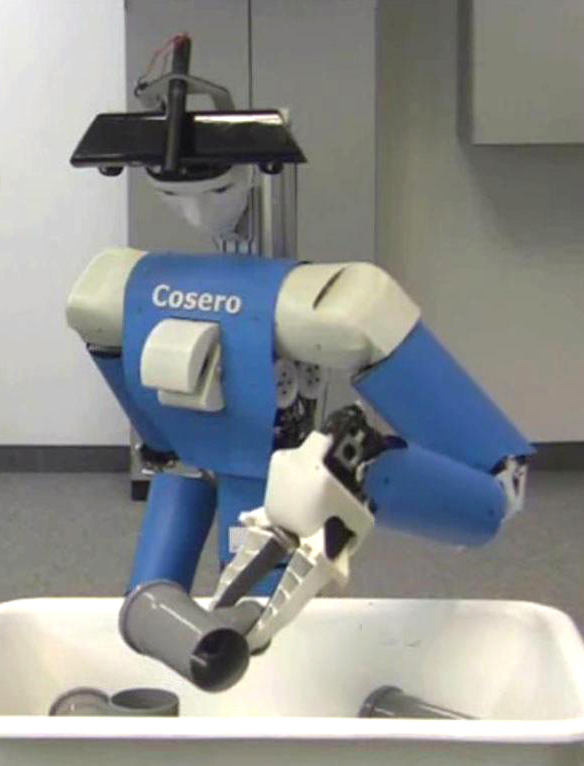
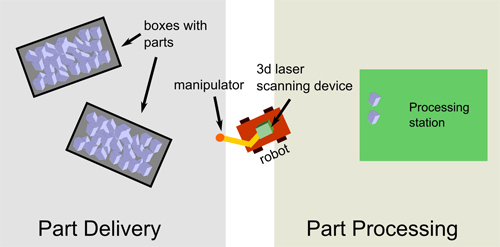
This experiment investigates a hyper-flexible cells scenario. In particular, we consider the following setting: A robot delivers parts to a process station. The parts are made available to the workspace of the robot in transport boxes that are not required to be packed in a systematic way. With its onboard 3D laser scanning sensor, the robot recognizes and identifies the topmost objects in the boxes. It grasps the parts out of the box and moves them to the station for further processing. The parts can be shaped nearly arbitrarily. We only assume that parts can be approximated by geometric shape primitives like e.g. cylinders or spheres. A new part type can be learned in a matter of minutes simply by presenting an exemplar to the robot.
The major challenges arising in this setting which will be addressed in the experiment are:
Dirk Holz, Matthias Nieuwenhuisen, David Droeschel, Jörg Stückler,
Alexander Berner, Jun Li, Reinhard Klein, and Sven Behnke:
Active Recognition and
Manipulation for Mobile Robot Bin Picking
Gearing up and accelerating cross-fertilization between academic and
industrial robotics research in Europe - Technology transfer
experiments from the ECHORD project, vol 94 of Springer Tracts in
Advanced Robotics (STAR), pp. 133-153, 2014.
Alexander Berner, Jun Li, Dirk Holz, Jörg Stückler, Sven Behnke,
and Reinhard Klein:
Combining Contour and Shape
Primitives for Object Detection and Pose Estimation of Prefabricated
Parts
In Proceedings of IEEE International Conference on Image Processing
(ICIP), Melbourne, Australia, September 2013.
Matthias Nieuwenhuisen, David Droeschel, Dirk Holz, Joerg Stückler,
Alexander Berner, Jun Li, Reinhard Klein, and Sven Behnke:
Mobile Bin Picking with an
Anthropomorphic Service Robot
In Proceedings of IEEE International Conference on Robotics and
Automation (ICRA), Karlsruhe, May 2013.
Matthias Nieuwenhuisen, Jörg Stückler, Alexander
Berner, Reinhard Klein, and Sven Behnke:
Shape-Primitive
Based Object Recognition and Grasping
In Proceedings of 7th German Conference on Robotics (ROBOTIK),
Munich, May 2012.
Dirk Holz, Matthias Nieuwenhuisen, David Droeschel, Jörg Stückler,
Sven Behnke, Alexander Berner, and Reinhard Klein:
Active Recognition and
Manipulation of Objects Based on Shape Primitives
Poster at 5th International Conference on Cognitive Systems (CogSys)
Vienna, February 2012.
University of Bonn, Institute for Computer Science, Computer Science VI - Intelligent Systems and Robotics Imprint Data Privacy Statement